
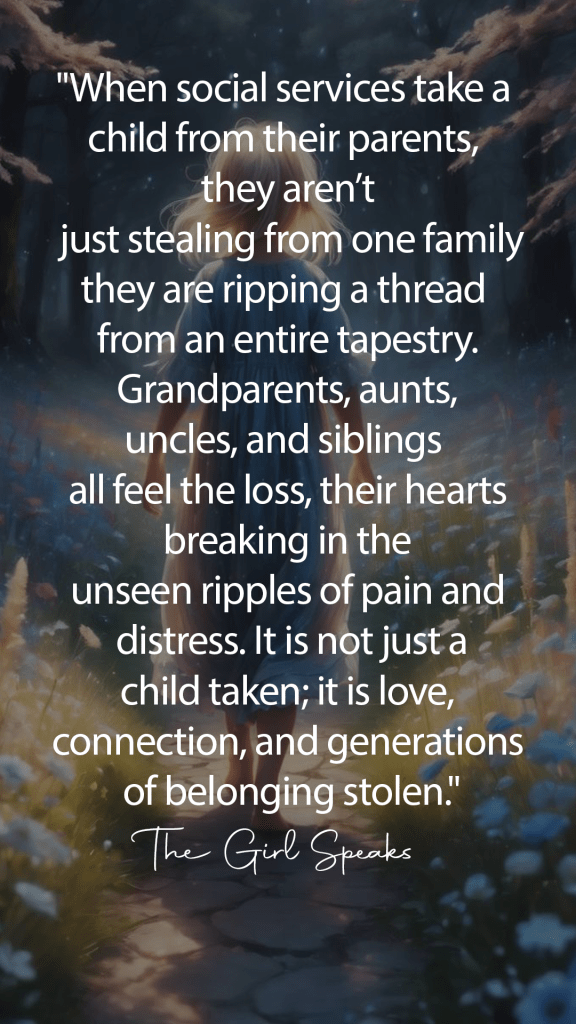
When social services take a child from their parents,
they aren’t just removing one person from one home.
They are ripping a thread from an entire tapestry.
A living, breathing, tangled web of love, connection, and history.
It is not just a child taken.
It is their grandmother’s lullabies, their sibling’s late-night whispers, their uncle’s jokes, their cousin’s hugs.
It is birthday traditions, inside jokes, childhood routines, and family recipes that will now gather dust in silence.
This kind of loss doesn’t make headlines.
It doesn’t get logged in the paperwork.
There is no column in a social worker’s form that records the sound of a grandparent sobbing behind a closed door,
or the ache of a sibling wondering if they’ll ever be whole again.
The impact ripples, silent, unseen, devastating.
Aunts and uncles who once held that child as a baby now hold only photos.
Grandparents who once babysat after school now sit in empty rooms filled with memories and quiet rage.
Siblings lose their playmate, their protector, their person, and sometimes, they’re too young to even understand why.
Social services say it’s about safety.
And yes, sometimes removal is necessary, in the rare, extreme cases where real danger exists.
But too often, it is used before support. Before understanding. Before families are given a real chance to heal together.
And when that happens, they’re not just “protecting” a child.
They are fracturing generations.
They are creating grief that doesn’t come with answers.
They are rewriting a family’s story with no regard for the love that lived there.
Family is more than a biological link.
It’s shared moments, generational bonds, roots that go deep and wide.
When you tear a child from that soil without care, you don’t just disrupt growth, you risk destroying an entire legacy.
So when they say “we’re taking the child,”
what they’re really saying is:
we’re taking the songs, the stories, the arms that held them before they could walk.
We’re taking the belonging that can’t be replaced by policy or placement.
And the ones left behind?
We don’t just miss them.
We carry the silence they left behind like a wound we weren’t allowed to bandage.
 thegirlspeaks.uk