
There’s a phrase I hear over and over again.
“They don’t take children for no reason.”
It’s often said confidently.
Sometimes kindly.
Sometimes as a full stop to a conversation that hasn’t even begun.
But the problem isn’t that people believe the system acts with reason.
The problem is that this phrase assumes reason equals truth, and that once a decision has been made, the context no longer matters.
It does.
Reason is not the same as understanding
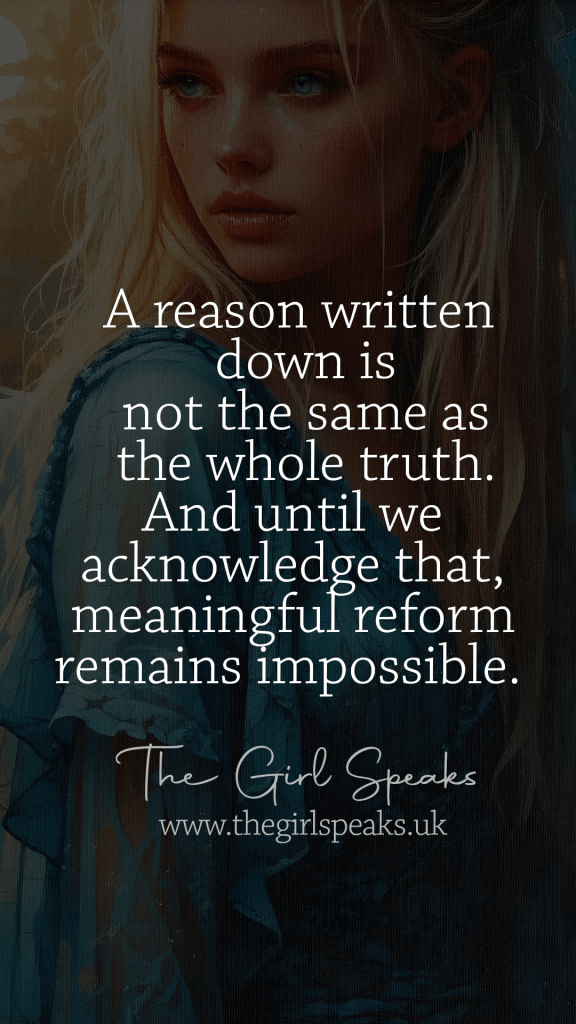
Yes, there is always a reason written down somewhere.
A report.
An assessment.
A risk narrative.
But those reasons are often shaped by:
- interpretation
- incomplete information
- professional bias
- time pressure
- fear of being blamed
- and systems that prioritise defensibility over curiosity
A reason can exist without being fair.
A reason can exist without being complete.
A reason can exist without being revisited, even when circumstances change.
And once a reason hardens into a conclusion, families often find themselves trying to disprove a version of themselves that never truly existed.
The myth of certainty
If removals were built on certainty, there would be no need for:
- sealed hearings
- restricted speech
- silence orders
- parents being warned about what they are “allowed” to say
Certainty doesn’t fear scrutiny.
Truth doesn’t require containment. And yet, so much of this system operates behind closed doors, not because all families are dangerous, but because complexity doesn’t fit neatly into paperwork.
What gets lost in the slogan
That phrase ~“they don’t take children for no reason” , flattens everything.
It erases:
- long histories that predate a single incident
- trauma responses mistaken for character flaws
- neurodivergence labelled as resistance
- parents asking for help and being judged for needing it
It turns deeply human stories into something binary:
good parent / bad parent
safe / unsafe
compliant / difficult
Real life doesn’t work like that.
This isn’t about denying harm
Saying this misses the point does not mean denying that harm happens.
Children do need protection.
Intervention is sometimes necessary.
But protecting children should never require:
- oversimplifying families
- freezing people in their worst moment
- or pretending the system itself is infallible
Accountability should flow in all directions.
The quieter truth
Most families affected by the system aren’t asking for denial. They’re simply asking for nuance.
They’re asking for:
- context to matter
- growth to be recognised
- support instead of suspicion
- and for their voices to count alongside professional ones
When people repeat that phrase, often unknowingly, they help uphold a narrative where questioning is seen as threat and silence is mistaken for compliance.#
When this phrase is repeated — often casually, often unknowingly — it reinforces a culture where questioning is framed as threat, and silence is mistaken for agreement.
Why this conversation matters
This is not about one case.
It is not about one family.
And it is not about proving or disproving guilt.
It is about recognizing that:
- stories do not begin at removal
- decisions do not exist in isolation
- and systems must be open to scrutiny if they are to remain just
Child protection does not happen in moments.
It happens in timelines human ones and those timelines deserve to be seen in full.
 thegirlspeaks.uk