
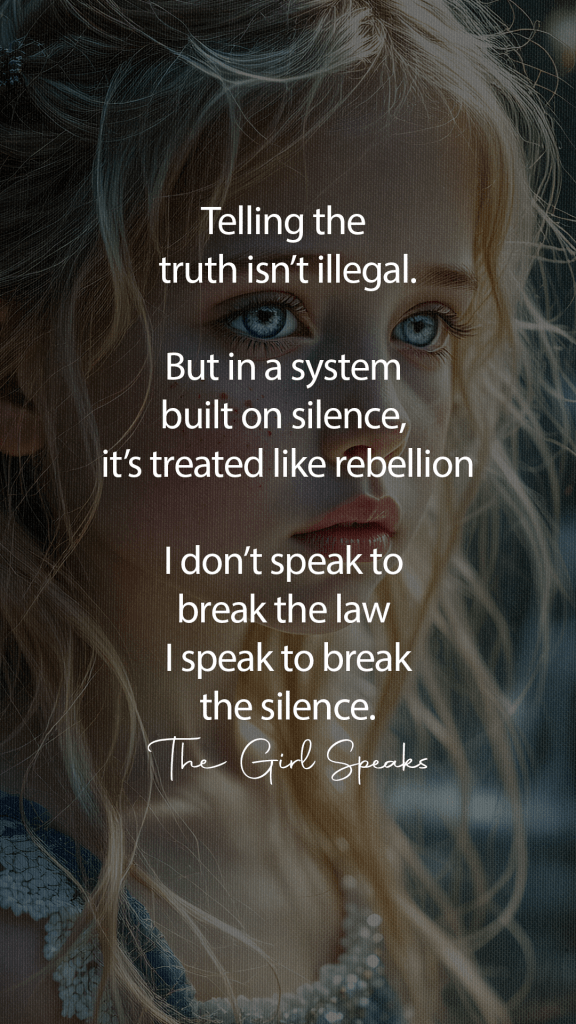
Telling the truth isn’t illegal.
But in a system built on silence, it’s treated like rebellion.
I don’t speak to break the law —
I speak to break the silence.
Because if telling the truth feels like a crime,
maybe it’s the silence that’s been guilty all along.
More and more parents, carers, and even young people with lived experience are finding the courage to speak out about what happened to them inside the family court or child protection system. And yet… too often, their honesty is met not with support, but with threats:
📩 Cease and desist letters
⚖️ Warnings of jail time
💬 Accusations of breaching confidentiality
It leaves many of us asking: What exactly are we doing wrong?
And more importantly: Is telling our story actually illegal?
Let’s talk about it — calmly, clearly, and with care.
What the Law *Actually* Says (UK Family Courts)
It’s true that family court proceedings are private — and it’s a criminal offence to publish certain information. But that doesn’t mean you can’t speak at all. Here’s a breakdown:
🚫 What You Can’t Do
These are the main legal boundaries:
– Don’t publish court documents, transcripts, or social worker reports.
– Don’t identify a child currently involved in care or court proceedings — this includes names, schools, and sometimes even indirect identifiers.
– Don’t share details of what was said inside a closed family court hearing without permission.
✅ What You *Can* Do
You *can* still speak out — just carefully:
– Talk about your own experience and feelings.
– Share the impact on your family and mental health.
– Speak in general or anonymised terms.
– Raise awareness of injustice or systemic failure.
– Reflect on how the process affected you without revealing specific court events or names.
If the case is no longer in court — or if your children are now adults — you have even more freedom, though it’s still wise to avoid naming others unless they’ve given consent.
Real-Life Example: What I Do
Right now, I have one child still in active proceedings. I don’t share court documents or private details about what was said or decided in those hearings.
I might mention that a hearing took place — that I was in court on a certain day — but I won’t talk about what happened inside that courtroom.
For my other children, whose cases are no longer in court (and two of whom are now adults), I speak about the pain, the confusion, the silence, and how it shaped us.
I change names. I use phrases like “one of my children” instead of naming them. I never post documents.
And still, I speak.
Not to shame.
Not to blame.
But because there is power in truth — and truth doesn’t have to be loud to be heard.
Speaking Out Safely: A Few Tips
1. Use aliases or “my child” rather than names.
2. Avoid specifics about court proceedings , think emotion over event.
3. Blur identifying details (school names, professionals, places).
4. Keep documents private, even if they feel validating — don’t post them.
5. Focus on your story, your truth, your voice.
Final Words
If you’re scared to speak, you’re not alone.
This fear isn’t your fault — it’s been built into the system to keep criticism quiet.
But fear doesn’t mean you’re wrong.
And silence doesn’t mean safety.
There is a way to tell the truth — legally, ethically, powerfully.
And sometimes, that whisper of truth can be louder than a courtroom.
If you’ve been threatened or feel unsure, please reach out. You’re not the only one navigating this.
Together, our voices can rise — not recklessly, but reclaimed.
Disclaimer : click to view
This post is based on my personal understanding and lived experience. I am not a legal professional, and nothing shared here should be taken as legal advice. If you’re unsure about what you can safely share, especially during active court proceedings, I strongly recommend speaking with a solicitor or legal advisor.
My goal is to raise awareness, not to break confidentiality — and to help others find their voice in a system that often silences us.
 thegirlspeaks.uk